
Like their peers in the rest of the Netherlands, children and adolescents in Bonaire, Saba and Sint Eustatius have a right to a good education. The Education Council notes that this right is not yet sufficiently guaranteed in practice. The Council advises the Minister of Education, Culture and Science (OCW) to ensure that legislation, policy and implementation are aligned more closely to the specific context in which education is realised on the islands. This requires extra effort and funding. The Council recommends that the various future pathways followed by young people from the islands be taken into account when organising education on Bonaire, Saba and Sint Eustatius, and that education organisations should be structurally supported.
Download in het Engels: Part A - Conclusions and recommendations
Download in het Engels: Part B - Featured themes in Bonaire, Saba and Sint Eustatius
Download in het Engels: Part C - Background information
Download in het Engels: Concise summary - Education in the Caribbean Netherlands
It is now more than fifteen years since education in Bonaire, Saba and Sint Eustatius became part of the Dutch education system. In the publication Education in the Caribbean Netherlands, the Education Council presents a comprehensive analysis of the functioning of the Dutch education system in those islands. At the request of the Minister of OCW, the Council is exploring what is needed to enable good education to be delivered within the frameworks of that system.
Develop a targeted approach for good education
The Minister of OCW is responsible for ensuring good education in both the Caribbean and European Netherlands. To fulfil this responsibility adequately, the Council recommends developing a targeted approach that can better respond to the specific circumstances on Bonaire, Saba and Sint Eustatius. In the Caribbean Netherlands, education is given in a small-scale, island environment at a great distance from the European part of the Netherlands. The enabling conditions to allow them to deliver good education within the framework of the Dutch education system are not present. Due to its remote location, education organisations in the Caribbean Netherlands have limited access to the instruments, resources and support from the European Netherlands to which education organisations in the European Netherlands do have access.
Structural vulnerabilities must not be turned into problems for individual education organisations. The Council therefore advises the Minister to ensure that the education organisations on the islands receive permanent support in the form of higher basic funding and targeted, practical measures. In addition, education legislation and policy efforts must be more in line with the circumstances and needs on the islands.
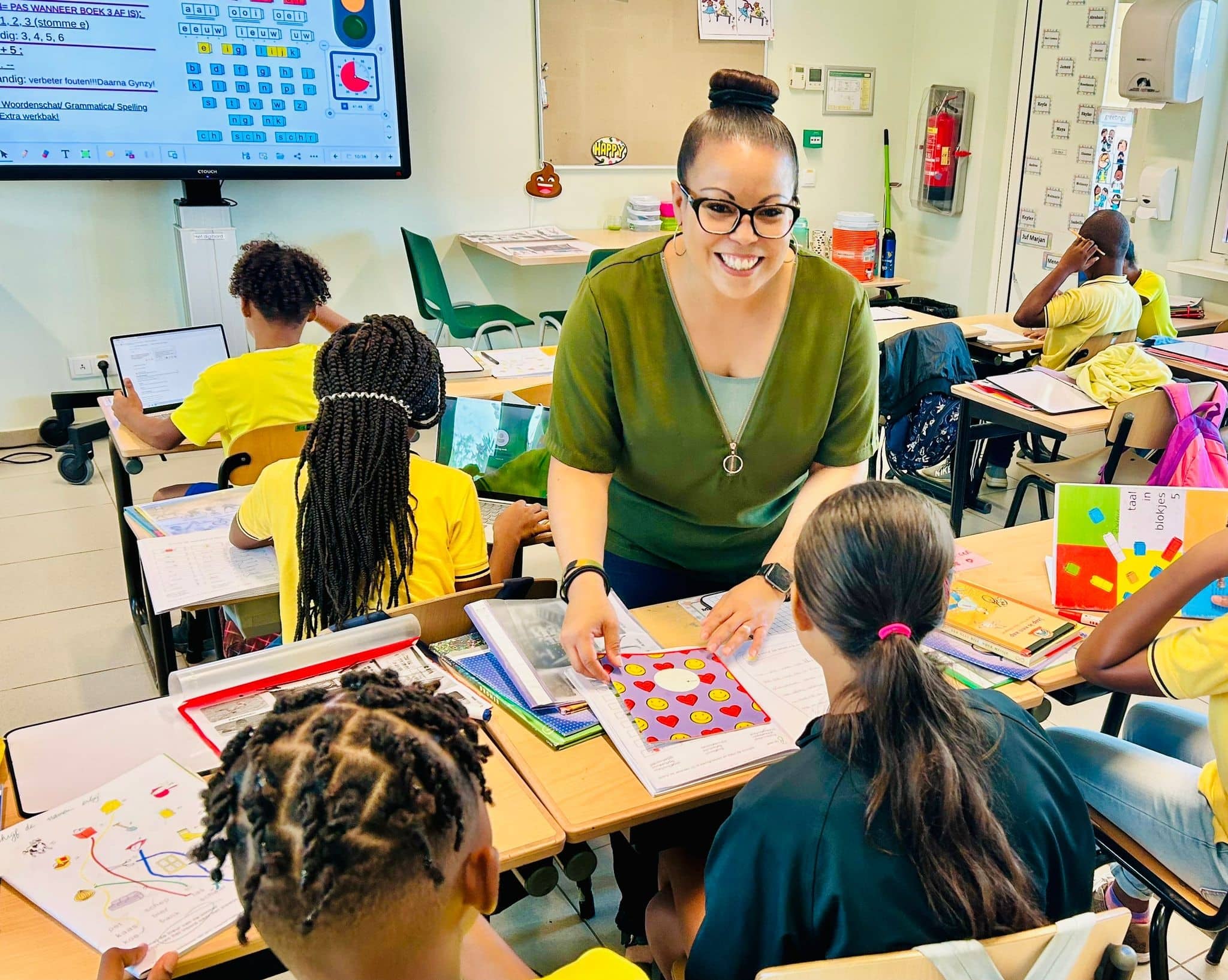
Beeld: © Onderwijsraad
Ensure students are sufficiently equipped for different future pathways
The Council recommends the Minister to take more account of the different future pathways of young people when organising education on Bonaire, Saba and Sint Eustatius, so that they can successfully move on to further education or work on the island, in the Caribbean region or in the European Netherlands. For example, young people now have the right to study in the European Netherlands. But in practice they encounter obstacles, such as the required command of the Dutch language and the limited alignment between the English-language education offered on Saba and Sint Eustatius (CXC education) and further education in the other parts of the Netherlands. The Education Council recommends to raise the standard of Dutch language teaching and that more differentiation be made possible in language education.
The Council also advocates strengthening and providing better financial support for transfer opportunities within the Caribbean region and the Kingdom and between Bonaire, Saba and Sint Eustatius. These routes can offer promising alternatives to studying in the European Netherlands. The latter route is now the most emphasized, both in education itself and in (financial) support.
Enable education organisations on Bonaire, Saba and Sint Eustatius to live up to their responsibilities
The pressure on teaching staff on the islands is increasing, turnover is high and vacancies are difficult to fill. In addition, due to an increasing size and diversity of students, education organisations have to deal with more complex educational and support needs. The Council recommends the Minister to provide structural support to education organisations in Bonaire, Saba and Sint Eustatius in recruiting and training teaching staff, and to facilitate training and knowledge sharing within and between teaching teams.
The Education Council also recommends increasing the quality and quantity of school board members and school principals on the islands. School board members and school principals can be better equipped with management development programs, improved induction programmes and the establishment of a support office.
About the publication Education in the Caribbean Netherlands
The publication Education in the Caribbean Netherlands consists of three parts:
- Part A: Conclusions and recommendations
- Part B: Featured themes in Bonaire, Saba and Sint Eustatius
- Part C: Background information
In Part B the Education Council uses six themes to shed light on the functioning of the Dutch education system in Bonaire, Saba and Sint Eustatius. This part was created in close collaboration with Island Committees set up for this purpose, consisting of people who work in education on the islands.